In today’s digital world, data plays an important role in how businesses, creators, marketers, and organizations make decisions. Instead of relying only on assumptions or personal opinions, people can use information and evidence to understand what is working and what needs improvement.
The Data Informed Manifesto represents a practical approach to using data as a valuable source of insight while still recognizing the importance of human experience, creativity, and judgment. It encourages people to ask better questions, examine evidence, test ideas, and make thoughtful decisions based on what they learn.
Hello friends! Welcome back to EditProTips. In this guide, we will explore the key ideas behind the data informed manifesto, how data-informed thinking works, its benefits, and practical ways you can apply it to everyday decisions.
Table of Contents
What Is the Data Informed Manifesto?
The Data Informed Manifesto is a way of thinking about decision-making where data and evidence are used to inform choices rather than automatically controlling every decision.
Being data-informed is slightly different from being completely data-driven. A data-driven approach may place strong emphasis on numerical measurements and analytics, while a data-informed approach combines data with context, experience, creativity, and human judgment.
In simple terms:
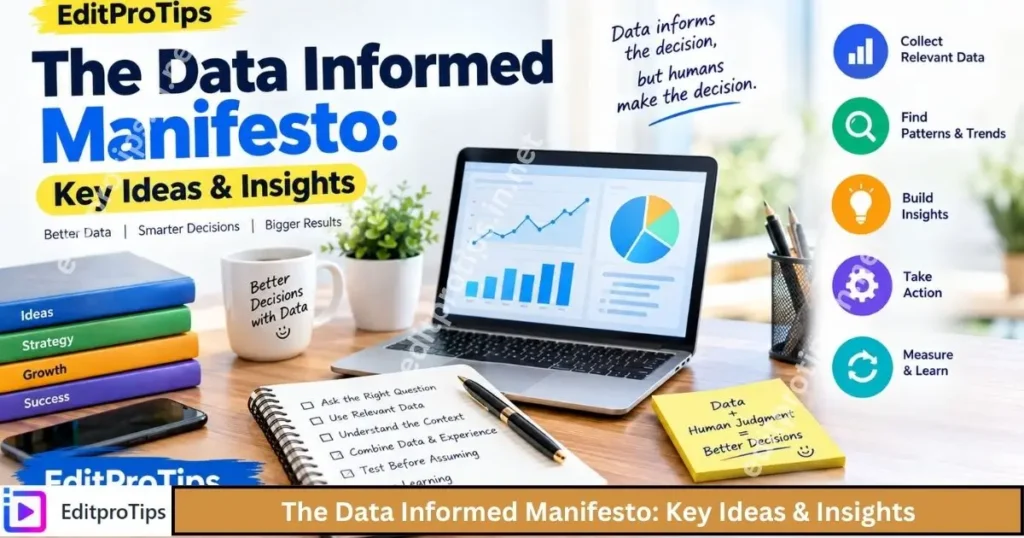
Data informs the decision, but humans make the decision.
For example, a website owner may notice that one article receives significantly more visitors than another. The analytics can provide useful information about traffic, engagement, and search performance. However, the website owner still needs to consider the quality of the content, audience needs, trends, and long-term goals before deciding what to publish next.

Why Is Data-Informed Thinking Important?
The amount of information available today is enormous. Websites, applications, social media platforms, search engines, and businesses continuously generate data.
Without a structured approach, it can be difficult to determine which information actually matters.
Data-informed thinking helps people:
- Understand patterns and trends
- Identify opportunities
- Measure performance
- Reduce unnecessary assumptions
- Test ideas before making major changes
- Understand audience behavior
- Improve strategies over time
- Make decisions with greater confidence
The goal is not to collect as much data as possible. The goal is to find useful information that helps answer important questions.
Data-Informed vs. Data-Driven
The terms “data-informed” and “data-driven” are often used interchangeably, but there is an important difference.
Data-Driven Decision Making
A data-driven approach generally places data at the center of the decision. Metrics, measurements, and statistical results may strongly influence what happens next.
Data-Informed Decision Making
A data-informed approach uses data as one important input among several. It combines analytics with experience, context, qualitative feedback, creativity, and professional judgment.
For example, suppose a social media post receives fewer views than expected.
A purely data-driven reaction might be to stop creating that type of content immediately.
A data-informed approach asks additional questions:
- Was the post published at the right time?
- Was the topic relevant to the audience?
- Was the title or thumbnail attractive?
- Did the platform algorithm change?
- Was the content promoted?
- What did audience comments say?
- Have similar posts performed differently?
This broader perspective can lead to better conclusions.
Key Principles of the Data Informed Manifesto
Although organizations may interpret data-informed thinking differently, several principles are particularly useful.
1. Start With the Right Question
Good decisions begin with good questions.
Instead of collecting random statistics, identify what you actually want to understand.
For example, instead of asking:
“How many people visited my website?”
you might ask:
“Which content attracts visitors who are most likely to engage with my website?”
The second question provides a clearer direction for analysis.
2. Use Relevant Data
Not every metric is useful for every decision.
A website might generate thousands of page views, but page views alone may not tell you whether visitors found the content helpful.
Depending on the goal, useful metrics could include:
- Organic traffic
- Click-through rate
- Engagement
- Conversion rate
- Returning visitors
- Search impressions
- Time spent on content
- User feedback
The right metric depends on the question you are trying to answer.
3. Understand the Context
Numbers do not exist in isolation.
A sudden increase in traffic could result from a successful marketing campaign, a seasonal trend, a viral social post, or an external event.
Likewise, a decrease in traffic does not automatically mean that content quality has declined.
Context helps explain why the numbers changed.
4. Combine Quantitative and Qualitative Information
Quantitative data tells you what happened.
Qualitative information can help explain why it happened.
For example, analytics may show that visitors leave a webpage quickly. User comments, surveys, reviews, or interviews may reveal that the page is difficult to understand.
Combining both types of information can create a much clearer picture.

5. Test Before Assuming
One of the strongest ideas behind data-informed thinking is experimentation.
Rather than assuming that one strategy will work, test it.
For example, a content creator could experiment with:
- Different headlines
- Different thumbnail designs
- Different publishing times
- Different content formats
- Different calls to action
The results can then provide evidence for future decisions.
6. Accept That Data Can Be Imperfect
Data is useful, but it is not automatically correct or complete.
Tracking systems can contain errors. Sample sizes can be too small. Metrics can be interpreted incorrectly. External factors can influence results.
Therefore, data should be questioned and evaluated rather than blindly trusted.
How to Apply Data-Informed Thinking
You do not need to be a professional data analyst to use data-informed decision making.
Here is a simple process.
Step 1: Define Your Goal
Start by identifying what you want to achieve.
For example:
Goal: Increase organic website traffic.
Step 2: Identify Important Metrics
Choose measurements that relate directly to your goal.
For SEO, you might examine:
- Search impressions
- Search clicks
- Keyword rankings
- Organic visitors
- Click-through rates
- Content performance
Step 3: Analyze the Information
Look for meaningful patterns rather than focusing on a single number.
Ask:
What changed?
When did it change?
What might have caused the change?
Step 4: Create a Hypothesis
Use the available evidence to form a reasonable explanation.
For example:
“Articles with clearer titles may receive more clicks from search results.”
Step 5: Test the Idea
Create or improve content based on the hypothesis and monitor the results.
Step 6: Learn and Adjust
The process does not end with one experiment.
Use the results to improve your next decision.
This creates a continuous cycle:
Question → Data → Insight → Action → Measurement → Learning
Benefits of Data-Informed Decision Making
Using a data-informed approach can provide several advantages.
Better Decision Quality
Evidence can help reduce decisions based purely on assumptions.
Improved Efficiency
Data can reveal which activities are producing useful results and which may need improvement.
Greater Audience Understanding
Website and social media analytics can reveal what topics, formats, and experiences audiences respond to.
Continuous Improvement
Instead of treating a strategy as permanent, data-informed thinking encourages ongoing testing and refinement.
Balanced Decision Making
One of the biggest advantages is balance. Data provides evidence while human judgment provides context and creativity.
Common Mistakes to Avoid
Data-informed thinking can also fail when data is misunderstood.
Focusing on Vanity Metrics
Large numbers may look impressive but may not contribute to your actual goal.
For example, a high number of views does not necessarily mean high engagement or successful conversions.
Making Decisions From Too Little Data
A single day’s results may not provide enough evidence to identify a reliable trend.
Ignoring Human Feedback
Analytics cannot always explain emotions, motivations, frustrations, or preferences.
Confusing Correlation With Causation
Two events happening at the same time does not necessarily mean one caused the other.
Collecting Data Without Taking Action
Data has little value if it never influences learning or decisions.
The Role of Data in Content Creation
Content creators can benefit significantly from data-informed thinking.
Suppose a creator publishes articles, videos, or social media posts regularly. Analytics can reveal which topics attract attention and which formats encourage engagement.
However, creators should not simply copy their most successful content forever.
Trends change, audiences evolve, and new topics emerge.
A better approach is to combine performance data with creativity.
For example:
Data: A particular topic generated strong engagement.
Insight: The audience appears interested in this subject.
Creative decision: Explore a related topic from a new angle.
This approach allows data to guide creativity without replacing it.

Data-Informed Thinking for SEO
SEO is another area where data can be extremely useful.
Website owners can analyze search impressions, clicks, keyword performance, engagement, and content trends to identify opportunities.
For example, if a page receives many search impressions but relatively few clicks, the title and meta description may deserve attention.
If a page receives traffic but does not satisfy visitors, the content may need improvement.
The important point is that SEO data should be used as a diagnostic tool, not as a reason to make changes blindly.
Frequently Asked Questions
What does the data informed manifesto mean?
The data informed manifesto represents an approach to decision-making where data and evidence inform decisions while human judgment, context, experience, and creativity remain important.
Is data-informed the same as data-driven?
Not exactly. Data-driven decision making often places data at the center of a decision, while data-informed decision making combines data with other factors such as experience, context, and qualitative feedback.
Why is data-informed decision making important?
It can help people make more thoughtful decisions, identify patterns, test ideas, understand audiences, and improve strategies over time.
Can small businesses use data-informed thinking?
Yes. Small businesses can use simple information such as website analytics, customer feedback, sales data, social media engagement, and search performance to make better decisions.
Is more data always better?
No. Relevant and reliable data is usually more valuable than large amounts of irrelevant information. The goal should be to collect information that helps answer meaningful questions.
Conclusion
The Data Informed Manifesto highlights an important idea: data should help people make better decisions, not remove human judgment from the decision-making process.
The strongest approach combines evidence with experience, context, creativity, and continuous learning.
Whether you are managing a website, creating content, running a business, or developing a digital strategy, you can start with a simple process: ask a meaningful question, find relevant data, analyze the evidence, test an idea, measure the result, and learn from what happens.
Data gives us information. Good thinking turns that information into useful action.
For more AI, editing, content, and digital insights, stay connected with EditProTips.