Technology is changing the way we work, learn, communicate, and live. From artificial intelligence and robotics to quantum computing and advanced cybersecurity, new innovations are creating exciting opportunities for businesses, students, developers, and everyday users. Understanding the latest Emerging Technology Trends can help you prepare for the future and discover new ways to use digital tools.
Welcome to EditPro Tips , your trusted source for technology updates, AI information, digital tools, and creative ideas. In this article, we will explore 10 emerging technology trends to watch in 2026, explain how they work, and discuss why they matter.
Table of Contents
What Are Emerging Technology Trends?
Emerging technology trends are new or rapidly developing technologies that have the potential to change industries, improve productivity, and solve real-world problems. Some technologies are already widely available, while others are still being researched, tested, or introduced to selected industries.
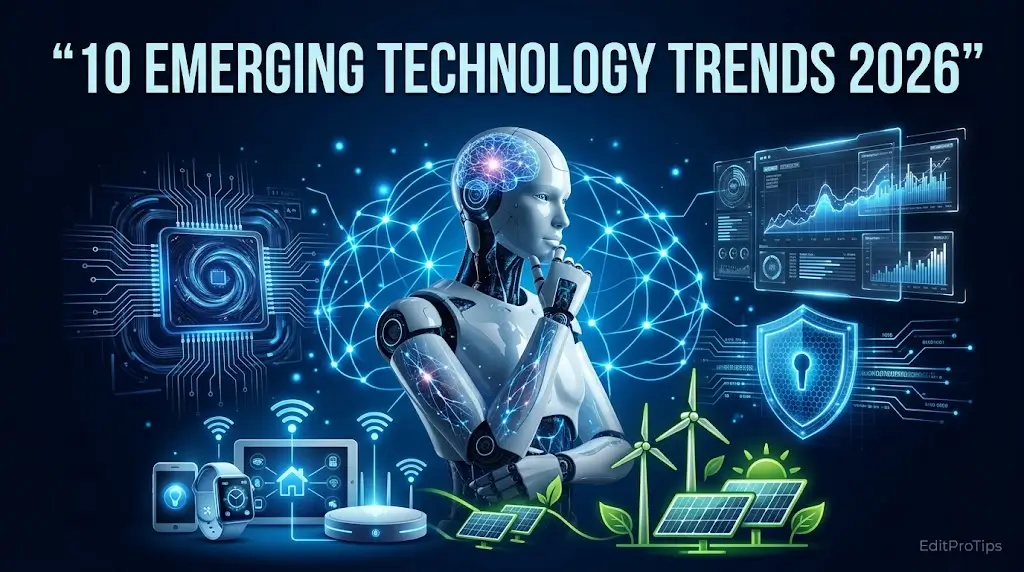
In 2026, major areas of technological development include AI-powered applications, intelligent automation, advanced computing, digital security, and more efficient energy systems. These developments are influencing healthcare, education, transportation, entertainment, manufacturing, and online business.
1. Artificial Intelligence Becomes More Advanced
Artificial intelligence (AI) remains one of the most important emerging technology trends in 2026. AI-powered tools can help users generate content, analyze information, create images, edit videos, write code, and automate repetitive tasks.
Generative AI tools are becoming increasingly useful for students, content creators, marketers, and businesses. Instead of completing every task manually, users can work with AI assistants to develop ideas, organize information, and speed up creative workflows.
For example, AI photo editing tools can enhance images, remove backgrounds, adjust lighting, and create different visual styles. AI video tools can help generate short clips, captions, animations, and social media content.
Why it matters: AI can improve productivity, support creativity, and help people complete many tasks more efficiently. However, users should verify AI-generated information and protect confidential data when using these tools.
2. AI Agents and Intelligent Automation
AI agents are systems designed to work toward a goal by interpreting instructions, using available tools, and carrying out multiple steps with varying levels of human supervision.
Unlike a basic chatbot that primarily responds to questions, an AI agent may help organize a workflow, retrieve information, prepare reports, or coordinate tasks across compatible applications.
Businesses are exploring AI agents for customer support, software development, research assistance, and administrative operations. Individuals may also use agent-based tools to organize projects or simplify everyday digital tasks.
Why it matters: Intelligent automation may reduce repetitive work and allow people to spend more time on planning, decision-making, and creative activities. Human oversight remains important, especially when actions affect money, personal information, or important business decisions.
3. Quantum Computing Advances
Quantum computing is an advanced approach to computation that uses principles of quantum mechanics. Unlike ordinary computers, which process information using conventional bits, quantum computers use quantum bits, commonly called qubits.
Researchers are working to improve qubit reliability, reduce errors, and develop useful quantum algorithms. Potential applications include selected chemistry simulations, materials research, and certain complex optimization problems.
However, practical quantum computing remains challenging. Today’s quantum systems are not replacements for everyday computers, and many proposed applications still require substantial research.
Why it matters: Continued progress could eventually help researchers investigate problems that are difficult to solve using conventional computing methods. Quantum computing may also affect cybersecurity, making research into quantum-resistant cryptography increasingly important.
4. Cybersecurity and AI-Powered Threat Detection
As more personal and business activities move online, cybersecurity is becoming increasingly important. Cybercriminals use techniques such as phishing, identity theft, malicious software, and social engineering to target individuals and organizations.
Modern security systems increasingly use machine learning and behavioral analysis to identify unusual activity, prioritize alerts, and help security teams respond to threats.
At the same time, attackers can use AI to create convincing scam messages, impersonations, and other deceptive content. This makes digital awareness and reliable security practices essential.
Why it matters: Individuals and businesses should use strong, unique passwords, enable multifactor authentication, install security updates, and verify unexpected messages before clicking links or sharing sensitive information.

5. Extended Reality: AR, VR, and Mixed Reality
Extended reality (XR) includes augmented reality (AR), virtual reality (VR), and mixed reality (MR). These technologies combine digital content with physical environments or create immersive virtual experiences.
AR can place digital information over a view of the real world. VR can immerse users in computer-generated environments, while MR can combine physical and digital elements in interactive ways.
In 2026, XR continues to offer opportunities in training, education, product demonstrations, gaming, design, and remote collaboration.
For example, students may explore simulated environments, technicians may practice procedures in virtual training spaces, and shoppers may preview how certain products could look in their homes.
Why it matters: XR can make learning and visualization more interactive. Wider adoption will depend on factors such as device cost, comfort, accessibility, and the availability of useful applications.
6. Robotics and Humanoid Robots
Robotics is progressing through improvements in sensors, computer vision, motion control, and AI. Robots are already used in manufacturing, warehouses, agriculture, healthcare support, and other specialized environments.
Humanoid robots are also receiving attention because their human-like form may allow them to operate in spaces designed for people. Nevertheless, performing complex tasks safely and reliably in unpredictable real-world environments remains difficult.
In the coming years, advances in robotics could support repetitive industrial work, material handling, inspection, and selected service tasks.
Why it matters: Robotics can improve consistency and productivity in suitable environments. Businesses must also consider worker safety, maintenance costs, workforce training, and how automation may change job responsibilities.
7. Edge Computing and Faster Data Processing
Edge computing processes data closer to where it is generated instead of sending every piece of information to a distant cloud data center.
This approach can help reduce delays, limit unnecessary data transfers, and support applications that need quick responses. Examples include industrial sensors, connected vehicles, smart cameras, and certain healthcare monitoring systems.
Cloud computing will continue to play an important role, but edge computing can complement cloud services when local processing is beneficial.
Why it matters: Faster local processing can support responsive applications and may reduce bandwidth requirements. Organizations must still manage device security, software updates, and data protection.
8. Internet of Things and Smarter Connected Devices
The Internet of Things (IoT) describes physical devices that connect to networks to collect, exchange, or act on data. These devices include smart thermostats, industrial sensors, connected appliances, wearable devices, and environmental monitoring equipment.
IoT systems can help users monitor conditions, automate certain activities, and make better use of collected information.
For example, a smart building may adjust lighting and temperature based on occupancy, while an industrial facility may use sensors to detect equipment problems before they cause major disruptions.
Why it matters: Connected devices can improve convenience and operational efficiency. However, weak passwords, outdated firmware, and poor privacy settings can create security risks.
9. Green Technology and Sustainable Computing
Green technology focuses on reducing environmental impact through cleaner energy, efficient resource use, and more sustainable industrial processes.
Technology companies are exploring improved battery systems, renewable energy integration, energy-efficient hardware, and methods for reducing data center power consumption.
As AI services and digital infrastructure expand, energy efficiency is becoming an important consideration. More efficient chips, better cooling systems, and smarter energy management can help reduce operational costs and resource use.
Why it matters: Sustainable technology can support environmental goals while helping organizations manage energy consumption. The real impact depends on how systems are designed, powered, maintained, and recycled.
10. Digital Twins and Smart Manufacturing
A digital twin is a digital representation of a physical object, system, or process that can be updated with real-world data. Depending on its design, it may help users monitor performance, test scenarios, or predict maintenance needs.
Manufacturers can use digital twins to study production lines, identify bottlenecks, and evaluate possible changes before implementing them in the real world.
Other potential applications include building management, transportation infrastructure, energy systems, and industrial equipment.
Why it matters: Digital twins can help organizations understand complex systems and make more informed decisions. Their usefulness depends on accurate data, appropriate models, and effective integration with existing operations.
How Emerging Technology Trends Will Affect Everyday Life
Emerging technologies are not limited to large companies or research laboratories. Many are becoming part of everyday digital experiences.
Here are some possible effects:
- Education: AI tutors, interactive learning tools, and virtual simulations may provide additional ways to study.
- Content creation: AI image generators, video editors, and writing assistants can help creators develop digital content.
- Healthcare: Data analysis, medical imaging support, and selected monitoring technologies may assist healthcare professionals.
- Business: Automation and analytics can help teams manage workflows and make decisions.
- Home and lifestyle: Connected devices can improve convenience, energy management, and home monitoring.
- Cybersecurity: More sophisticated security tools can help detect suspicious activity, although users still need safe online habits.
These benefits are not guaranteed in every situation. Cost, reliability, privacy, accessibility, regulation, and human oversight all influence how successfully a technology is adopted.
Benefits and Challenges of Emerging Technologies
New technologies can create opportunities, but they can also introduce challenges.
Major benefits
- Improved productivity: Automation can help reduce repetitive manual tasks.
- Better decision-making: Data analysis can reveal patterns and support planning.
- Creative opportunities: AI tools can help users explore new ideas and produce digital content.
- New career paths: Developing technologies create demand for skills in software, security, data, robotics, and infrastructure.
- Potential efficiency gains: Smart systems can improve resource use in suitable applications.
Important challenges
- Privacy concerns: Digital systems may collect sensitive personal or business data.
- Cybersecurity threats: Connected tools can introduce new security vulnerabilities.
- Skill gaps: Workers and students may need additional training to use new systems effectively.
- Implementation costs: Hardware, software, maintenance, and training can be expensive.
- Accuracy and reliability: AI systems may make mistakes or produce misleading results.
The best approach is to evaluate new tools carefully, understand their limitations, and choose technologies that solve genuine problems.

How to Prepare for Future Technology Trends
You do not need to become an expert in every new technology. Instead, focus on learning practical skills and understanding how innovations relate to your interests.
Here are five useful steps:
- Learn AI fundamentals: Understand what AI tools can do, where they fail, and how to use them responsibly.
- Improve digital skills: Develop your knowledge of productivity tools, online research, and basic data analysis.
- Explore cybersecurity: Learn about password managers, multifactor authentication, phishing, and privacy settings.
- Practice with real projects: Experiment with AI-assisted editing, automation, coding, or data visualization.
- Follow reliable technology news: Compare sources and distinguish demonstrated capabilities from marketing claims or predictions.
For content creators, learning AI image editing, video production, and responsible prompt writing can be a practical starting point. Students may prefer programming, data analysis, or cybersecurity fundamentals, depending on their career goals.
Frequently Asked Questions
What are the top emerging technology trends in 2026?
Major trends include artificial intelligence, AI agents, quantum computing, cybersecurity, extended reality, robotics, edge computing, the Internet of Things, green technology, and digital twins.
Which technology is growing rapidly in 2026?
AI is a major area of development, especially generative AI, AI-assisted software development, and agent-based automation. Growth and adoption vary by industry, region, and application.
How will emerging technologies affect jobs?
Some tasks may become automated, while other roles may change or emerge. The effects will vary by occupation. Learning adaptable digital skills, critical thinking, communication, and responsible AI use can help people prepare.
Is artificial intelligence the future of technology?
AI is likely to remain an important part of technological development, but it is not the only important field. Advances in energy, computing, robotics, security, and connected infrastructure will also shape the future.
How can beginners learn about emerging technologies?
Beginners can start with introductory courses, practical AI tools, basic programming, cybersecurity fundamentals, and reputable technology publications. Small projects are often a useful way to turn theoretical knowledge into practical experience.
Why should we follow emerging technology trends?
Following technology trends helps individuals understand new opportunities, recognize potential risks, develop relevant skills, and make more informed decisions about digital tools.
Conclusion
The 10 Emerging Technology Trends to Watch in 2026 demonstrate how innovation is influencing modern life. AI, intelligent automation, quantum computing, cybersecurity, robotics, connected devices, and sustainable computing all offer opportunities, but each also comes with limitations and challenges.
The most useful strategy is to stay informed, experiment responsibly, and focus on technologies that solve real problems. Whether you are a student, entrepreneur, developer, or content creator, understanding these developments can help you prepare for a changing digital world.