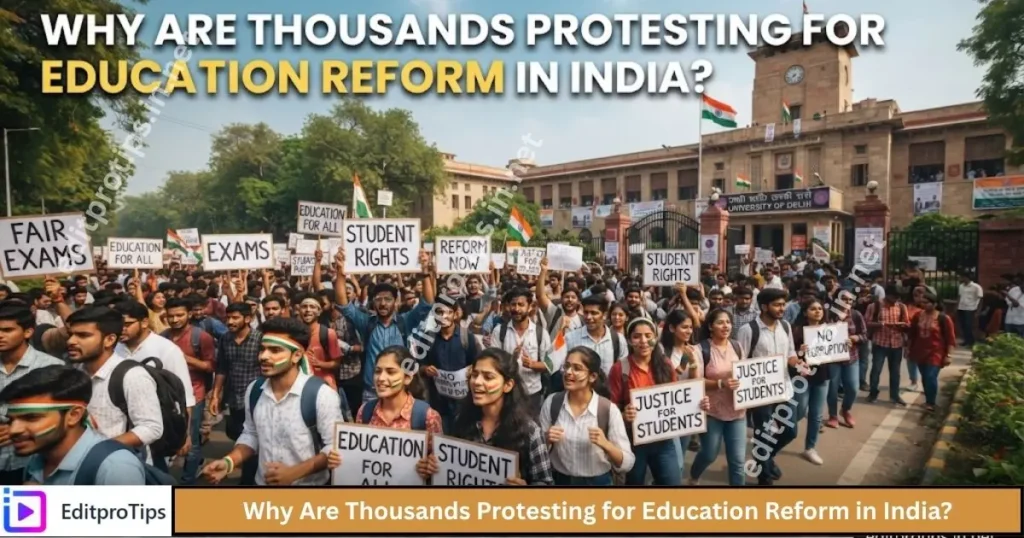
India’s education system has become the focus of growing public debate as students and young people demand greater fairness, transparency, and accountability. In 2026, a major youth-led protest movement emerged following controversy surrounding the NEET-UG medical entrance examination. Demonstrators called for action over alleged examination paper leaks and wider problems affecting students’ futures.
The movement attracted attention across the country and developed into a broader discussion about education, unemployment, student welfare, and government accountability. Although the central demand of the July protests was linked to examination irregularities, other students have raised concerns about the everyday conditions in schools, including shortages of teachers and basic facilities.
This article explains why thousands protested for education reform in India, what students demanded, how the movement developed, and what its wider implications could be.
Table of Contents
Why Are Thousands Protesting for Education Reform in India?
Thousands of young people joined demonstrations in 2026 because they wanted answers about examination integrity and accountability after allegations of a NEET-UG paper leak. The controversy intensified concerns about whether students could trust competitive examinations that determine access to highly sought-after university courses.
The youth-led Cockroach Janta Party movement became a prominent organiser of demonstrations in New Delhi. Protesters demanded the resignation of Union Education Minister Dharmendra Pradhan and called for stronger action against those responsible for examination irregularities.
According to reporting by Reuters and Al Jazeera, the protests grew beyond one examination issue, reflecting wider frustration among young Indians over education, employment prospects, and public accountability.
On July 25, 2026, Pradhan resigned. Protest organisers subsequently announced that they were ending their agitation following the resignation and the government’s response to their demands.
The events marked a significant moment in the debate over education reform in India, although the resignation alone could not resolve every problem facing the country’s education system.
1. Alleged Examination Paper Leaks
One of the main reasons behind the protests was the controversy over the NEET-UG 2026 examination, which is used for admission to undergraduate medical courses.
For students preparing for competitive examinations, a paper leak can create serious concerns about fairness. Candidates may spend months or years studying, attending coaching classes, and preparing for a single opportunity to secure a place in a medical college.
Allegations of leaked examination material raised questions about whether every candidate had an equal opportunity to compete.
Students demanded investigations, accountability, and safeguards to prevent similar incidents in the future. The controversy also highlighted the importance of protecting examination papers, investigating suspected misconduct, and communicating clearly with candidates when irregularities arise.
2. Demand for Fair and Transparent Examinations
Competitive examinations play a significant role in determining access to higher education in India. As a result, students expect examination authorities to follow consistent procedures and apply the same rules to every candidate.
When allegations of misconduct emerge, students may question the reliability of the results and the decisions made by examination authorities.
Protesters called for greater transparency and accountability. Their concerns included the handling of examination irregularities, the treatment of affected candidates, and the need for credible investigations.
A transparent examination system should provide clear procedures for reporting suspected wrongdoing, reviewing evidence, communicating decisions, and protecting candidates from unfair disadvantages.
3. Pressure on Students and Their Families
Competitive examinations can place considerable pressure on students and their families. Preparation may involve long study hours, expensive coaching, travel, accommodation, and repeated attempts to qualify.
When an examination is affected by suspected irregularities or cancellation, students can face uncertainty about their academic plans and future careers.
The NEET controversy brought renewed attention to the emotional and financial consequences of high-stakes examinations. News reports also described student deaths by suicide associated with the wider crisis, intensifying calls for accountability and better support.
It is important not to reduce these tragedies to a single cause. Student mental health is influenced by multiple factors, and students facing distress need accessible, confidential support alongside improvements to examination procedures.
4. Concerns About the Education System
The protests also became a platform for discussing broader concerns about India’s education system.
Students and education advocates have raised questions about unequal access to quality teaching, differences between public and private institutions, the availability of learning resources, and the high cost of preparing for competitive examinations.
For some students, access to quality education depends heavily on family income and where they live. Students in rural or underserved communities may have fewer coaching options, limited digital resources, or difficulty accessing well-equipped schools.
Reform discussions therefore extend beyond examinations. They also include the quality of classroom teaching, educational infrastructure, affordability, and equal opportunities for students from different backgrounds.
5. Shortages of Teachers and Basic School Facilities
Not every education-related protest in India has focused on university entrance examinations.
In September 2026, Al Jazeera reported on schoolchildren protesting conditions in government schools, including demands for teachers, classroom furniture, safe buildings, drinking water, electricity, and toilets.
These concerns demonstrate the difference between two connected issues: making competitive examinations fair and ensuring that children receive adequate education before they reach those examinations.
A student cannot fully benefit from educational opportunities if their school lacks essential facilities or sufficient teaching staff.
Addressing these problems requires attention to local conditions, school funding, teacher recruitment, maintenance, and the monitoring of public education services.
6. Youth Unemployment and Uncertain Career Prospects
Education and employment are closely connected. Many young people pursue degrees and competitive examinations because they hope to secure stable jobs and improve their economic circumstances.
When career opportunities appear limited, frustration can grow over the relationship between educational achievement and employment prospects.
The 2026 youth protest movement also reflected wider concerns about unemployment and underemployment. Some participants viewed education reform as part of a broader demand for greater accountability and better opportunities for young people.
However, education policy and employment policy are not identical. Improving examination integrity is important, but creating more jobs also depends on economic growth, skills development, investment, and the availability of suitable employment.
7. Demand for Accountability from Authorities
Another central issue was accountability.
Students wanted authorities to explain what had happened, investigate alleged wrongdoing, and establish measures to prevent similar problems in the future.
The demand for the education minister’s resignation became a major focus of the July demonstrations. His resignation on July 25 marked an important development in the protest movement.
Nevertheless, long-term reform requires more than changes in leadership. It also involves effective investigations, reliable examination procedures, clear responsibilities, and meaningful communication with students.
Whether reforms succeed depends on their implementation and on whether they restore confidence in the institutions responsible for education.
What Is the Cockroach Janta Party Movement?
The Cockroach Janta Party (CJP) was a youth-led movement that became prominent during India’s 2026 student protests.
Despite its name, it was a protest movement rather than a conventional political party contesting elections. It began as a satirical online initiative and grew into a platform for young people expressing dissatisfaction with examination controversies and wider institutional problems.
Its visibility increased as demonstrations gathered in New Delhi and other locations. The movement helped bring students’ concerns to a broader audience and made the education minister’s resignation a central demand.
The episode also illustrated how social media can help organise young people, spread information, and turn a specific controversy into a wider public debate.

How Did the Government Respond?
During the July protests, Prime Minister Narendra Modi pledged stern action against those responsible for examination paper leaks and promised fast-track courts to address the issue, according to Al Jazeera’s reporting at the time.
The controversy also prompted demands for stronger legal and administrative safeguards against examination fraud.
On July 25, Education Minister Dharmendra Pradhan announced his resignation. Protest organisers then said they would call off their agitation following the resignation and the government’s response to their demands.
These developments were important, but individual promises and leadership changes should not be confused with completed systemic reform. The effectiveness of any measures must be assessed through their implementation, investigation outcomes, and the reliability of future examinations.
What Education Reforms Are Students Seeking?
The specific demands differ between protest groups and regions, but the debates point to several areas for potential reform:
- Secure examinations: Stronger safeguards for confidential examination papers and digital systems.
- Independent investigations: Credible inquiries into allegations of examination fraud.
- Clear communication: Timely information about cancellations, retests, results, and appeals.
- Student support: Better access to counselling and mental health services.
- Affordable preparation: Greater access to quality learning resources beyond expensive coaching.
- Improved public schools: Sufficient teachers, safe classrooms, clean drinking water, toilets, electricity, and learning materials.
- Accountability: Clear responsibilities for institutions and officials when failures occur.
- Equal opportunity: Policies that help students from disadvantaged and underserved communities access quality education.
These measures address different problems and would require coordination between examination authorities, schools, universities, state governments, and the central government.
What Could Education Reform Mean for India’s Future?
Education reform could have consequences extending well beyond examination results.
A more reliable examination system can strengthen trust in qualifications and admissions. Better-resourced schools can help students build foundational skills. Affordable learning opportunities can reduce some barriers faced by students whose families cannot pay for extensive coaching.
Support for student well-being may also help educational institutions respond more effectively to stress and uncertainty.
However, reforms require planning, funding, monitoring, and public accountability. Changes announced after a protest need to be evaluated against measurable results, rather than judged only by the promises made at the time.
The wider challenge is to ensure that educational opportunities are not determined solely by a student’s ability to pay for additional resources or navigate an unreliable process.
Frequently Asked Questions
Why are thousands protesting for education reform in India?
The major 2026 youth protests were triggered by allegations of a NEET-UG examination paper leak. Demonstrators demanded accountability and the education minister’s resignation, while the wider debate included education quality, employment concerns, and student welfare.
What was the NEET-UG controversy?
NEET-UG is an entrance examination for undergraduate medical courses in India. Allegations of a paper leak in 2026 raised concerns about examination security, fairness, and the treatment of affected candidates.
Who organised the 2026 student protests?
The youth-led Cockroach Janta Party movement became a prominent organiser of the demonstrations, particularly in New Delhi.
Did India’s education minister resign?
Yes. Dharmendra Pradhan announced his resignation as Union Education Minister on July 25, 2026, amid the protests over examination irregularities.
Will these protests change India’s education system?
The long-term impact depends on whether authorities implement effective reforms and whether those measures improve examination security, school conditions, access to education, and public confidence.
Conclusion
The 2026 protests for education reform in India highlighted the importance of fairness, transparency, and accountability in a system that influences millions of students’ futures.
The NEET-UG controversy was the immediate trigger for the major youth-led movement, but the broader debate also involves educational inequality, school facilities, student well-being, and employment prospects.
The resignation of the education minister was a major development in July 2026. Lasting progress, however, depends on the implementation of effective safeguards and improvements that students can experience in examinations, classrooms, and access to educational opportunities.
For students, families, teachers, and policymakers, the central question remains how to build an education system that is trustworthy, accessible, and capable of giving every learner a fair opportunity to succeed.
Stay connected with EditProTips for more educational explainers, technology updates, and important news stories.