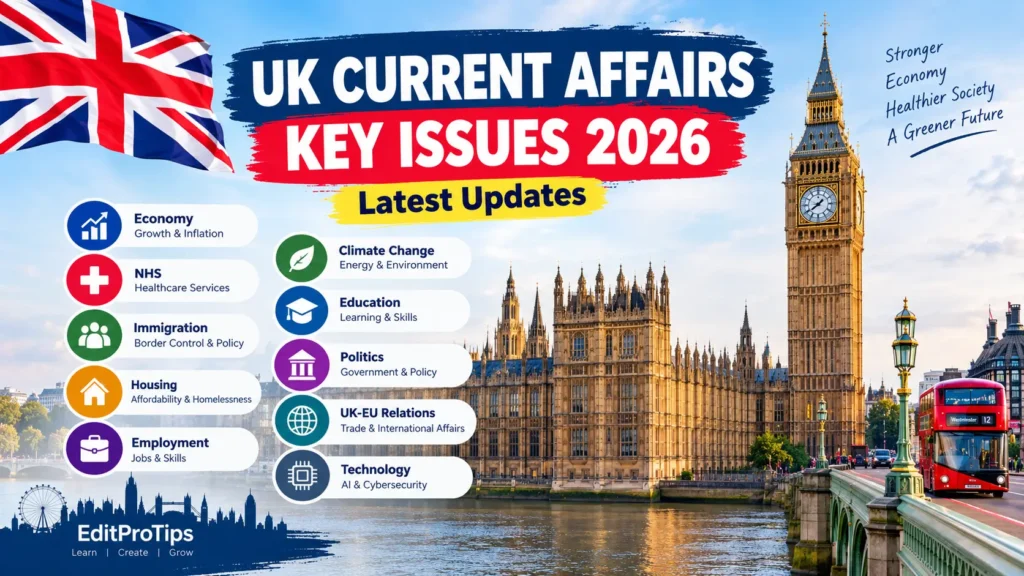
The United Kingdom continues to face important political, economic, social, and environmental challenges in 2026. From the rising cost of living and pressure on public services to immigration, housing, climate change, and international relations, these issues are shaping national discussions and government decisions.
For students, competitive examination candidates, news readers, and anyone interested in British politics, understanding UK Current Affairs Key Issues 2026 is essential. This guide explains the major topics, recent developments, and important questions to follow throughout the year.
Table of Contents
UK Current Affairs 2026: Latest Overview
UK current affairs cover the events, policies, and public debates affecting people across England, Scotland, Wales, and Northern Ireland. The main issues include economic stability, healthcare, immigration policy, housing affordability, employment, energy security, and the country’s international relationships.
The upcoming Autumn Budget is also an important development. The House of Commons Library confirmed that the 2026 Budget Statement is scheduled for 28 October 2026, with updated economic forecasts expected alongside it. The decisions announced will be important for households, businesses, and public finances.

1. UK Economy and Cost of Living
The economy remains one of the central issues in British current affairs. Household budgets are affected by the prices of food, transport, energy, housing, and other essential goods and services.
Recent inflation figures underline these pressures. According to reporting based on Office for National Statistics data, annual UK consumer price inflation reached 3.5% in September 2026, compared with 3.1% in August. Higher motor fuel costs contributed to the increase.
The upcoming Budget is therefore receiving attention from households, businesses, and economic analysts.
Key points to watch:
- Inflation and changes in everyday prices.
- Household energy and transport costs.
- Interest rates and mortgage affordability.
- Taxation and government spending.
- Economic growth and business investment.
The effect of these developments will differ between households, depending on income, savings, borrowing, and living costs.
2. NHS and Healthcare Services
The National Health Service (NHS) remains a major public concern. Patients and healthcare professionals continue to focus on waiting times, access to GPs, hospital capacity, staffing, and the modernisation of medical facilities.
In July 2026, the government announced a 10-year capital plan for health and social care. It includes plans to modernise NHS buildings, upgrade GP surgeries, replace ageing equipment, and bring more services closer to patients.
Important healthcare issues include:
- Reducing waiting times for treatment.
- Improving access to primary care.
- Recruiting and retaining healthcare workers.
- Modernising hospitals and medical equipment.
- Improving mental health and social care services.
The central question is how effectively investment and service reforms can improve access to timely, high-quality care.
3. Immigration and Border Control
Immigration remains a significant topic in UK politics. Public discussions include border security, asylum applications, work visas, labour shortages, refugee protection, and the management of immigration rules.
In October 2026, the Home Office announced further immigration policy developments, including proposed reforms relating to immigration and asylum legislation. These developments reflect continuing debates about enforcement, legal safeguards, and the UK’s approach to migration.
Key issues include:
- Managing asylum applications and case backlogs.
- Preventing people-smuggling operations.
- Reviewing visa rules and eligibility requirements.
- Supporting lawful migration while enforcing immigration law.
- Balancing border management with humanitarian responsibilities.
Immigration policy affects employers, public services, migrants, local communities, and international relationships. Its practical effects depend on the details of individual policies and how they are implemented.

4. Housing Affordability and Homelessness
Housing is another important UK current affairs issue in 2026. High housing costs can make it difficult for young people, low-income households, and first-time buyers to secure suitable accommodation.
Rent levels, mortgage costs, the supply of new homes, and the availability of social housing all contribute to the debate.
Major housing concerns include:
- Affordable homes for first-time buyers.
- Rising or unaffordable private rents.
- Homelessness and temporary accommodation.
- Building more homes in areas with high demand.
- Improving the condition and energy efficiency of existing properties.
Housing policy must also consider infrastructure, transport, planning, and access to schools and healthcare. Building more homes is only part of the challenge; affordability and location also matter.
5. Employment, Wages, and Skills
Employment and wages are essential to the UK’s economic outlook. Workers are concerned about pay, job security, career opportunities, and whether wages are keeping pace with living costs.
The latest available Office for National Statistics figures at the time of writing estimated the unemployment rate at 4.7% for June to August 2026. Labour market estimates can be revised, so readers should consult the latest official release when using these figures for research or examinations.
Important employment topics include:
- Changes in unemployment and job vacancies.
- Wage growth and household purchasing power.
- Apprenticeships and vocational training.
- Skills shortages in key industries.
- Artificial intelligence and workplace automation.
Preparing workers for changing technology and helping businesses develop new skills will remain important to productivity and long-term economic growth.
6. Climate Change and Energy Security
Climate change is an important environmental and economic issue for the United Kingdom. Flooding, heatwaves, biodiversity loss, and pressure on natural resources have increased the importance of climate adaptation and environmental protection.
Energy security is closely connected to this discussion. International disruptions and fluctuations in oil and gas prices can affect transport costs, household bills, and business expenses.
Key areas to follow include:
- Expanding renewable energy.
- Improving home insulation and energy efficiency.
- Reducing greenhouse gas emissions.
- Protecting communities from flooding and extreme weather.
- Maintaining reliable and affordable energy supplies.
The UK must consider environmental targets alongside energy reliability, infrastructure costs, and the financial effects on consumers.
7. Education and Skills Development
Education remains central to Britain’s long-term economic and social development. Schools, colleges, universities, and training providers help prepare young people for employment and support adults who need new skills.
Important education debates include teacher recruitment, school funding, student wellbeing, university costs, and access to technical education.
Key priorities include:
- Improving educational outcomes.
- Supporting teachers and school staff.
- Expanding apprenticeships and vocational training.
- Preparing students for digital and AI-related careers.
- Making education accessible to learners from different backgrounds.
Education policy is particularly important as employers increasingly seek digital literacy, communication skills, technical knowledge, and adaptability.
8. UK Politics and Government Policy
Political developments influence taxation, public spending, healthcare, education, housing, immigration, and foreign policy. Government announcements and parliamentary debates therefore remain essential parts of UK current affairs.
In October 2026, parliamentary business included scrutiny of legislation and discussions concerning public services, infrastructure, and economic policy. The upcoming Budget is another major event to monitor.
Readers should follow:
- New legislation and parliamentary debates.
- Government spending and taxation decisions.
- Reports from parliamentary committees.
- Devolved government policies in Scotland, Wales, and Northern Ireland.
- Public accountability and the implementation of government commitments.
For balanced understanding, distinguish between an announced policy, a bill progressing through Parliament, a law that has received the required approval, and a measure that has actually been implemented.
9. UK-EU Relations and International Affairs
The UK’s relationship with the European Union continues to affect trade, travel, security, migration, and diplomatic cooperation.
In October 2026, the UK government announced plans for a further UK-EU summit in Brussels on 20 November 2026. Discussions about future cooperation make this an important area to watch.
International affairs also include the UK’s relationships with NATO allies, support for Ukraine, global trade, and responses to international conflicts.
Important questions include:
- How can the UK and EU improve practical cooperation?
- What changes could affect trade and businesses?
- How is the UK working with international security partners?
- How do global conflicts affect energy prices and economic stability?
The outcomes of diplomatic meetings depend on the agreements reached and any subsequent implementation.
10. Technology, Artificial Intelligence, and Cybersecurity
Technology is increasingly important to British businesses, public services, education, and national security. Artificial intelligence can improve productivity and support new services, but it also raises questions about privacy, employment, misinformation, and accountability.
Cybersecurity is another major concern as organisations depend more heavily on digital systems.
Key technology issues include:
- Responsible use of artificial intelligence.
- Protecting personal data.
- Preventing cyberattacks and online fraud.
- Developing digital skills.
- Supporting innovation while maintaining appropriate safeguards.
The challenge is to encourage useful technological progress while protecting people, businesses, and essential services from avoidable risks.

Why Are UK Current Affairs Important in 2026?
Following current affairs helps people understand how government decisions and economic changes affect everyday life. It also helps students prepare for general knowledge tests, interviews, debates, and competitive examinations.
Regular news reading can improve knowledge of public policy, international relations, economics, and social issues.
To stay informed:
- Read reliable news reports regularly.
- Check official statistics before quoting figures.
- Follow parliamentary announcements and policy updates.
- Compare different perspectives on controversial issues.
- Record important dates, reports, and policy changes.
- Review whether proposed measures have actually taken effect.
Reliable information is especially important when a political announcement or headline is still developing.
Frequently Asked Questions
What are the main UK current affairs key issues in 2026?

Major issues include the economy, cost of living, NHS services, immigration, housing affordability, employment, climate change, education, politics, international relations, and artificial intelligence.
What is the biggest economic issue in the UK in 2026?
Inflation and the cost of living remain important concerns. Interest rates, housing costs, wages, economic growth, and government finances are also significant.
Why is the UK Autumn Budget 2026 important?
The Budget is expected on 28 October 2026. It will set out government fiscal decisions and be accompanied by updated economic and public-finance forecasts.
What are the main challenges facing the NHS?
Important challenges include waiting times, access to primary care, workforce capacity, hospital facilities, and the effective use of healthcare funding.
How can I prepare for UK current affairs questions?
Read reliable news sources, review official government and statistical publications, follow parliamentary developments, and make concise notes on important events and dates.
Where can I find reliable UK current affairs updates?
The Office for National Statistics provides official economic and labour market data. UK Parliament publishes information about legislation and debates, while GOV.UK publishes official government announcements.
Conclusion
The UK Current Affairs Key Issues 2026 reflect the challenges and opportunities facing Britain across its economy, public services, society, environment, and international relationships. The cost of living, NHS access, immigration policy, housing, employment, and the upcoming Autumn Budget are particularly important topics to follow.
For the most accurate picture, readers should combine current reporting with official statistics and parliamentary information. Keeping track of new announcements and distinguishing confirmed decisions from proposals will help students, professionals, and general readers build a clearer understanding of Britain’s changing situation.