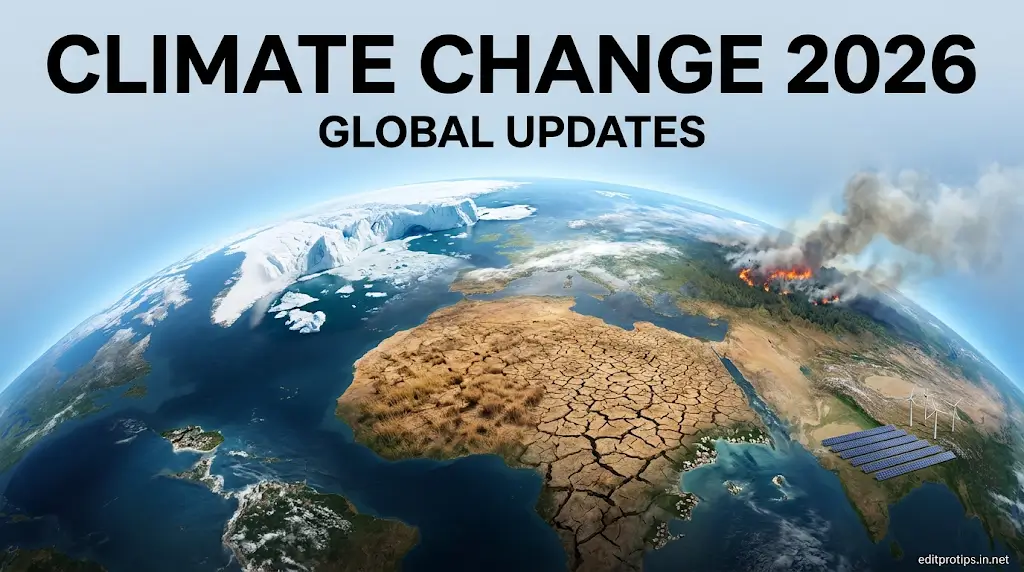
Climate change is one of the most important global challenges in 2026. Rising temperatures, melting ice, warming oceans, extreme weather events, and increasing greenhouse gas emissions continue to affect people and ecosystems worldwide. Governments, scientists, and environmental organizations are working to reduce emissions and prepare communities for climate-related risks.
The latest Climate Change Updates 2026 highlight an urgent message: the world needs faster action to limit global warming, protect natural resources, and build a more sustainable future. Although renewable energy and climate policies are making progress, current efforts are not yet sufficient to meet international temperature goals.
In this article, EditProTips explores the latest global climate developments, their environmental and economic impacts, and the practical steps individuals and governments can take.
Table of Contents
Latest Climate Change Updates 2026
Several major developments are shaping the global climate conversation in 2026.
According to the United Nations Environment Programme (UNEP), its October 2026 Emissions Gap Report warns that global warming is expected to exceed the 1.5°C threshold above pre-industrial levels. Under current policies, warming could reach approximately 2.8°C by 2100. If countries fully implement their current climate pledges, the projection falls to around 2.6°C.
The report emphasizes that deep and rapid reductions in greenhouse gas emissions remain essential to limit the scale and duration of temperature overshoot.
Meanwhile, the World Meteorological Organization (WMO) expects global temperatures to remain at or near record levels over the next five years. Its May 2026 outlook also highlights the growing risk of temporarily exceeding 1.5°C of warming in individual years.
These findings demonstrate why climate action remains a worldwide priority.
1. Global Temperatures Continue to Rise
Rising global temperatures are among the clearest indicators of climate change. Human activities, especially burning coal, oil, and natural gas, release greenhouse gases that trap heat in the atmosphere.
In 2026, climate monitoring agencies continue to report exceptionally high temperatures.
The Copernicus Climate Change Service reported that September 2026 was the second-warmest September on record. Global temperatures also exceeded 1.5°C above pre-industrial levels for the second consecutive month in August and September.
However, a monthly or annual temperature above 1.5°C does not by itself mean the long-term Paris Agreement temperature threshold has been permanently crossed. That threshold concerns long-term global warming, rather than a single month or year.
Higher temperatures can increase the likelihood and severity of heatwaves, place pressure on water supplies, and affect agriculture, public health, and natural ecosystems.

2. Extreme Weather Events Affect More Communities
Extreme weather remains a major concern in the latest climate change updates. Many regions face dangerous heat, heavy rainfall, flooding, drought, and wildfire risks.
Climate change does not directly cause every individual weather event. However, it can change the likelihood, intensity, or duration of certain extremes.
Heatwaves
Longer and more intense heatwaves can increase the risk of heat exhaustion, heatstroke, and other health problems. They can also raise electricity demand as households and businesses use more cooling.
Flooding and Heavy Rainfall
A warmer atmosphere can hold more moisture, increasing the potential for intense rainfall in suitable weather conditions. Flooding can damage homes, roads, farms, and essential infrastructure.
Drought and Water Shortages
Higher temperatures can increase evaporation and worsen water stress in some regions. Drought can threaten crops, livestock, food supplies, and drinking-water resources.
Wildfires
Hotter, drier conditions can increase fire danger in many areas, although wildfire risk also depends on vegetation, land management, wind, and human activity.
These risks highlight the importance of early-warning systems, emergency planning, resilient infrastructure, and reliable climate information.
3. Oceans Are Getting Warmer
The oceans absorb most of the excess heat accumulated in the climate system. Ocean warming contributes to rising sea levels, affects marine ecosystems, and can influence weather patterns.
Marine heatwaves are periods when ocean temperatures remain unusually high. They can damage coral reefs, disrupt fisheries, and affect marine biodiversity.
A 2026 update on climate indicators reported that global marine heatwave days more than tripled between 1991 and 2025. The research also identified continuing increases in greenhouse gas concentrations and global warming.
Ocean warming also contributes to sea-level rise through the expansion of seawater as it heats. Melting glaciers and ice sheets add more water to the oceans.
Coastal communities and low-lying islands are particularly vulnerable to these changes. Protecting coastal wetlands, restoring mangroves, and improving flood planning can help reduce some risks.
4. Melting Glaciers and Polar Ice Remain a Concern
Glaciers and polar ice play an important role in Earth’s climate system. Their continued loss is one of the most visible consequences of global warming.
When glaciers shrink, communities that depend on glacial meltwater may face changes in seasonal water availability. Melting land ice also contributes to sea-level rise.
The Arctic is warming faster than the global average in many climate assessments. Changes in snow cover and sea ice can influence ecosystems and affect the livelihoods of people living in northern regions.
Scientists continue to monitor ice sheets, glaciers, and sea levels to understand how these changes may develop over coming decades.
Reducing greenhouse gas emissions is essential to limiting further warming, while adaptation measures can help communities prepare for changes that are already underway.

5. Renewable Energy Is Expanding Worldwide
One positive development in the climate change updates for 2026 is the continued growth of renewable energy.
Solar and wind power can generate electricity without the direct carbon emissions associated with burning fossil fuels. Renewable electricity, energy storage, and improved electricity grids are becoming increasingly important parts of climate strategies.
UNEP’s October 2026 report notes that renewable electricity capacity has grown faster than anticipated following the adoption of the Paris Agreement.
Key areas of progress include:
- Solar energy: Solar panels help households, businesses, and utilities generate electricity.
- Wind power: Onshore and offshore wind projects provide low-carbon electricity.
- Battery storage: Batteries can store electricity for use when solar or wind generation is lower.
- Energy efficiency: Efficient appliances, buildings, and industrial equipment can reduce energy consumption.
- Electric transportation: Electric vehicles can reduce transport emissions when supported by cleaner electricity.
Nevertheless, progress remains uneven between countries. Expanding clean energy requires investment, reliable infrastructure, supportive policies, and improved access to affordable technologies.
6. Greenhouse Gas Emissions Remain a Major Challenge
Greenhouse gases include carbon dioxide, methane, and nitrous oxide. These gases trap heat in the atmosphere and contribute to global warming.
The main sources include fossil-fuel combustion, industrial activity, transportation, agriculture, and land-use changes.
The 2026 climate indicators update reported that global greenhouse gas emissions reached approximately 56.8 billion tonnes of carbon dioxide equivalent in 2024, the latest year covered by that emissions estimate.
This demonstrates the gap between climate ambitions and the speed of global emissions reductions.
UNEP’s October 2026 report identifies substantial cuts as necessary to pursue a pathway that returns global warming to 1.5°C by the end of the century after a temporary overshoot.
For its lowest-overshoot scenario, the report estimates that global greenhouse gas emissions would need to fall by 18% by 2030, 45% by 2035, and 69% by 2040, relative to 2025 levels.
Achieving reductions of this scale will require coordinated action from governments, businesses, industries, and communities.
7. Climate Change Impacts on Agriculture and Food Security
Agriculture depends on suitable temperatures, reliable rainfall, healthy soil, and access to water. Climate change can disrupt these conditions and make food production more difficult in vulnerable regions.
High temperatures can damage crops during important growing stages. Drought can reduce harvests, while floods can destroy farmland and agricultural infrastructure.
Changing climate conditions can also affect livestock health, pests, and the availability of irrigation water.
Potential consequences include:
- Reduced crop yields in vulnerable areas.
- Higher production costs for farmers.
- Greater pressure on water resources.
- Disruptions to food supply chains.
- Increased food-price instability.
Farmers can respond through climate-resilient crop varieties, improved irrigation, soil conservation, diversified planting, and better weather forecasting.
Governments can also strengthen food storage, emergency assistance, and agricultural insurance to help communities manage climate-related losses.
8. Global Climate Policies and International Cooperation
International cooperation is essential because greenhouse gas emissions and climate impacts cross national borders.
The Paris Agreement remains a central international framework for limiting global warming. Countries submit climate action plans, known as nationally determined contributions, and work toward reducing emissions and adapting to climate impacts.
In October 2026, UNEP warned that existing policies and pledges remain insufficient to meet the world’s temperature goals.
The report calls for faster progress on renewable energy, energy efficiency, reducing methane and other non-carbon-dioxide emissions, transitioning away from fossil fuels, and protecting forests.
Climate negotiations also provide opportunities for countries to discuss climate finance, technology transfer, adaptation, and support for vulnerable communities.
The effectiveness of international agreements depends on implementation, funding, accountability, and stronger national policies.

9. Climate Change and Its Economic Effects
Climate change can affect economies through damage to infrastructure, reduced agricultural productivity, health impacts, disrupted supply chains, and increased disaster-recovery costs.
Businesses may face higher insurance costs and interruptions caused by extreme weather. Governments may need to spend more on emergency response, water management, and rebuilding damaged infrastructure.
At the same time, the transition to cleaner energy can create opportunities in renewable power, energy-efficient construction, electric transportation, and environmental technology.
Investing in climate resilience can help limit future losses. Examples include improving drainage systems, strengthening buildings, protecting coastlines, and designing cities that reduce heat exposure.
Planning ahead is often more effective than waiting until a disaster occurs.
10. What Can Individuals Do to Help Fight Climate Change?
Although large-scale policy changes are essential, individual choices can also contribute to lower emissions and stronger environmental awareness.
Here are practical actions people can take:
- Save electricity: Switch off unused lights and equipment, and choose energy-efficient appliances.
- Use public transportation: Walk, cycle, carpool, or use public transport when practical.
- Reduce food waste: Plan meals carefully and store food properly.
- Choose reusable products: Reduce unnecessary single-use packaging and disposable items.
- Protect green spaces: Support tree planting and the conservation of local habitats.
- Conserve water: Repair leaks and use water efficiently, particularly in water-stressed areas.
- Support clean energy: Explore suitable renewable-energy options and energy-saving improvements.
- Stay informed: Follow reliable scientific information from recognized climate organizations.
- Encourage action: Support effective environmental policies and sustainable practices in your community.
Individual actions are most effective when combined with changes in energy systems, transport, industry, agriculture, and public policy.
What Is the Future of Climate Change After 2026?
The future of climate change will depend heavily on how quickly global greenhouse gas emissions decline.
Without stronger action, the world faces increasing risks from heat extremes, rising seas, ecosystem damage, and other climate-related impacts. Current-policy projections remain above the temperature goals established under the Paris Agreement.
However, the future is not predetermined. Faster emissions reductions, cleaner energy, forest protection, and effective adaptation can reduce the risks associated with additional warming.
Governments can strengthen climate policies, businesses can invest in lower-emission technologies, and communities can prepare for extreme weather.
The next several years will be important for determining the scale of future climate risks. Every meaningful reduction in emissions can help limit additional warming and protect people and ecosystems.
Frequently Asked Questions
What are the latest Climate Change Updates 2026?
Major updates include continued high global temperatures, warming oceans, growing climate risks, and warnings that current emissions policies are insufficient to meet international temperature goals. Renewable energy expansion remains an important positive development.
Is 2026 one of the hottest years on record?
Global temperatures remain near record levels. The WMO’s May 2026 outlook estimated an 86% chance that at least one year between 2026 and 2030 would surpass 2024 as the warmest year on record. The final ranking of 2026 will depend on complete observations.
What is causing climate change?
The main cause of current long-term global warming is human activity, particularly burning fossil fuels, deforestation, and other activities that increase greenhouse gas concentrations in the atmosphere.
How does climate change affect the world?
Climate change can increase heat risks, contribute to sea-level rise, intensify some heavy-rainfall events, worsen drought in certain regions, damage ecosystems, and threaten agriculture, infrastructure, and human health.
Can climate change still be slowed down?
Yes. Rapid and sustained reductions in greenhouse gas emissions can limit additional warming. Adaptation measures can also help communities prepare for impacts that cannot be avoided.
What are governments doing about climate change in 2026?
Governments are pursuing renewable energy, energy efficiency, emissions-reduction policies, climate adaptation, and international cooperation. However, current policies and national pledges still fall short of the reductions needed to meet the world’s temperature goals.
How can students help reduce climate change?
Students can conserve electricity and water, reduce waste, use sustainable transportation where possible, participate in environmental activities, and share accurate climate information with their communities.
Conclusion
The latest Climate Change Updates 2026 show that global warming remains a serious challenge. Rising temperatures, warmer oceans, melting ice, extreme weather risks, and high greenhouse gas emissions demonstrate the need for urgent and sustained action. At the same time, renewable energy, climate policies, scientific research, and community initiatives provide opportunities to make progress.
The world needs stronger international cooperation, faster emissions reductions, better adaptation planning, and greater public awareness. By combining government leadership with responsible business practices and practical individual actions, societies can work toward a safer and more sustainable future.