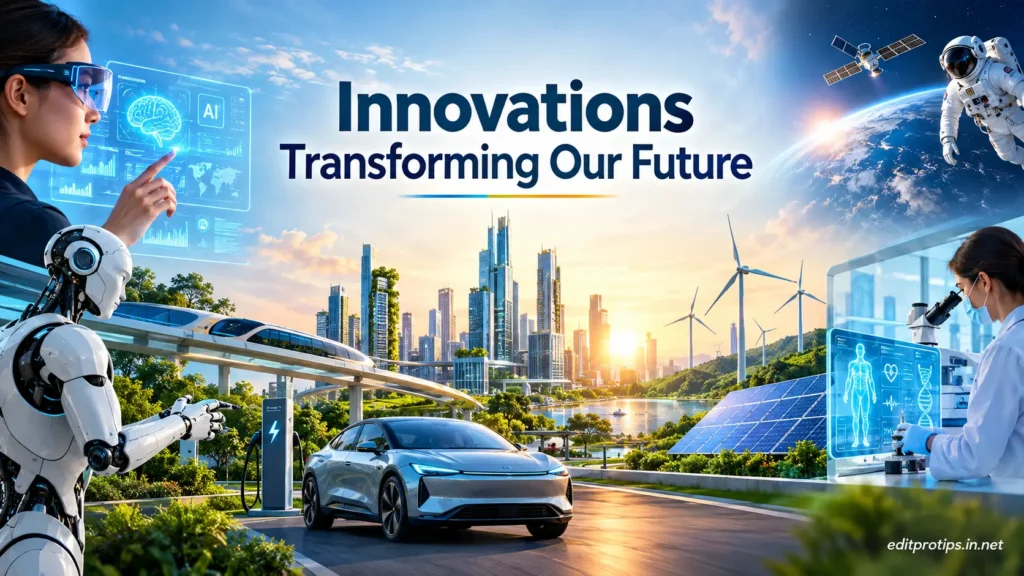
Innovations Transforming Our Future is an important topic that highlights how modern technology, scientific discoveries, and creative ideas are changing the world. From artificial intelligence and robotics to renewable energy and space exploration, innovations are transforming how people live, work, communicate, and solve problems. These developments are creating new opportunities while helping society prepare for future challenges.
In this essay, we will explore the most important innovations transforming our future, their benefits, their challenges, and how they may shape the world in the coming years.
Table of Contents
Introduction: Innovations Transforming Our Future
Innovation is the process of developing new ideas, products, methods, and technologies to improve people’s lives. Throughout history, inventions such as electricity, computers, and the internet have changed the way societies function. Today, technological progress is happening faster than ever.
The innovations transforming our future include artificial intelligence, biotechnology, clean energy, smart transportation, virtual reality, and advanced communication systems. These technologies are helping businesses become more efficient, improving healthcare, supporting environmental protection, and making information more accessible.
However, innovation also brings challenges, including privacy concerns, job displacement, cybersecurity risks, and unequal access to technology. Understanding these changes is essential for building a better and more sustainable future.

1. Artificial Intelligence and Machine Learning
Artificial intelligence (AI) is one of the most influential innovations transforming our future. AI systems can analyze information, recognize patterns, generate content, and assist people with complex tasks.
Machine learning, a branch of AI, enables computers to improve their performance by learning from data. These technologies are used in education, healthcare, business, entertainment, transportation, and many other industries.
For example, AI-powered tools can help students understand difficult subjects, assist doctors in analyzing medical images, and support businesses with customer service. Content creators can also use AI to generate ideas, edit images, and produce videos more efficiently.
In the future, AI may help solve complicated problems in science, agriculture, and environmental protection. Nevertheless, responsible development is necessary to address misinformation, privacy concerns, bias, and the impact of automation on employment.
2. Renewable Energy and Green Technology
Climate change and environmental pollution have increased the need for cleaner energy sources. Renewable energy technologies, including solar panels, wind turbines, and hydropower systems, are helping reduce dependence on fossil fuels.
Solar energy converts sunlight into electricity, while wind energy uses turbines to generate power. Improvements in battery storage are also making it easier to store renewable electricity for use when sunlight or wind is unavailable.
Green technology includes electric vehicles, energy-efficient buildings, smart electricity grids, and systems that reduce waste. These innovations can help communities lower emissions and use natural resources more responsibly.
In the coming years, advances in renewable energy may make clean electricity more accessible and affordable. Governments, companies, and individuals all have a role to play in supporting sustainable solutions.
3. Robotics and Automation
Robotics is another major development shaping the future. Robots can perform repetitive, dangerous, or highly precise tasks in factories, hospitals, warehouses, and agricultural environments.
Industrial robots help manufacturers produce goods consistently, while surgical robots can assist trained medical professionals with certain procedures. Agricultural robots may help monitor crops, remove weeds, and improve harvesting efficiency.
Automation can increase productivity and reduce human exposure to hazardous working conditions. However, it may also change the demand for certain jobs.
To prepare for these changes, workers may need to develop new skills in technology, problem-solving, communication, and creative thinking. The goal should be to use robots to support human capabilities rather than overlook the needs of workers and communities.
4. Medical Technology and Biotechnology
Medical innovation is improving the prevention, diagnosis, and treatment of diseases. Advanced medical imaging, wearable health devices, robotic assistance, and AI-supported diagnostic tools are changing healthcare.
Biotechnology also offers promising developments. Researchers are studying gene-based treatments, improved vaccines, and new methods of developing medicines. Personalized medicine aims to tailor certain treatments to a patient’s characteristics and medical needs.
Wearable devices can monitor measurements such as heart rate and activity levels, helping people understand aspects of their health. Telemedicine also allows patients to consult healthcare professionals remotely when appropriate.
Although these technologies offer significant opportunities, they raise important questions about affordability, patient privacy, safety, and equal access. Medical innovations must be carefully tested and responsibly implemented to benefit society.
5. Smart Cities and the Internet of Things
Smart cities use digital technologies to improve urban services, transportation, energy use, and public infrastructure. The Internet of Things (IoT) connects devices such as sensors, vehicles, appliances, and monitoring systems so they can exchange information.
For example, smart traffic signals can respond to changing traffic conditions, while connected energy meters can help households monitor electricity consumption. Sensors may also help cities detect water leaks, monitor air quality, and improve waste collection.
These systems can make urban environments more efficient and convenient. However, collecting information from connected devices creates privacy and cybersecurity concerns.
Successful smart cities must combine technological progress with reliable infrastructure, public accountability, data protection, and services that work for people from different backgrounds.
6. Electric Vehicles and Future Transportation
Transportation is undergoing significant changes through electric vehicles, advanced driver-assistance systems, and improved battery technologies.
Electric cars use electric motors instead of conventional petrol or diesel engines. They can reduce direct vehicle emissions, particularly when charged using low-carbon electricity. Electric buses and delivery vehicles are also becoming important parts of transportation planning.
Researchers are exploring better batteries, faster charging systems, and more efficient public transportation. Autonomous driving technology is another area of development, although its capabilities and safety limitations vary across systems.
In the future, cleaner transportation could help reduce urban air pollution and improve energy efficiency. Wider adoption will depend on charging infrastructure, vehicle affordability, battery supply chains, and reliable safety standards.
7. Virtual Reality and Augmented Reality
Virtual reality (VR) and augmented reality (AR) are changing the ways people learn, work, communicate, and experience digital content.
VR creates an immersive digital environment that users can explore through compatible devices. AR adds digital information to a view of the real world.
In education, these technologies can help students explore scientific models, historical environments, and practical simulations. In healthcare, they can support selected training and rehabilitation activities. Businesses can use immersive tools for product demonstrations, design, and employee training.
As these technologies improve, they may create more interactive learning experiences and new forms of digital entertainment. Developers must also consider accessibility, user comfort, privacy, and the cost of equipment.
8. Space Exploration and Satellite Technology
Space exploration continues to expand scientific knowledge and improve technologies used on Earth. Satellites support weather forecasting, navigation, telecommunications, environmental monitoring, and disaster response.
Space agencies and private companies are also developing spacecraft, exploring the Moon, and researching possibilities for future missions to Mars.
Satellite data can help scientists monitor deforestation, track storms, study ocean conditions, and identify changes in the Earth’s environment. These applications demonstrate that space technology has practical benefits beyond exploration.
Future missions may provide new scientific discoveries, but they also face substantial costs, technical difficulties, and safety challenges. Responsible space exploration should consider orbital debris, international cooperation, and the long-term sustainability of space activities.

9. Quantum Computing and Advanced Computing
Quantum computing is an emerging field that uses principles of quantum physics to process information in fundamentally different ways from conventional computers.
Researchers are investigating how quantum computers might help solve particular problems in chemistry, materials science, optimization, and other specialized areas. However, practical quantum computing remains challenging, and these systems are not replacements for ordinary computers in every situation.
Meanwhile, conventional computing continues to advance through more efficient processors, cloud platforms, and specialized AI hardware.
Together, these developments may help researchers model complex systems, discover new materials, and improve certain scientific processes. Progress will depend on overcoming technical limitations and demonstrating reliable real-world applications.
10. Education Technology and Digital Learning
Education technology is making learning resources available to more people. Online courses, digital libraries, educational applications, and AI-powered learning assistants can help students study at their own pace.
Teachers can use digital tools to create interactive lessons, explain difficult concepts, and provide additional practice. Video lessons and virtual classrooms also allow learners to access educational opportunities beyond their local communities.
For students and creators, digital skills are increasingly valuable. Learning how to use computers, evaluate online information, and work with new technologies can improve future career opportunities.
However, not everyone has equal access to reliable internet connections, suitable devices, or quality educational resources. Future education systems should combine technological innovation with human guidance, critical thinking, and affordable access.
Benefits of Innovations Transforming Our Future
Modern innovations offer several important benefits to individuals, businesses, and society.
- Improved productivity: Automation and digital tools can help people complete tasks more efficiently.
- Better healthcare: Medical research and diagnostic technologies can support disease prevention and treatment.
- Environmental protection: Renewable energy and cleaner transportation can help reduce pollution.
- Greater connectivity: Communication technologies make it easier to share information across the world.
- More learning opportunities: Online education provides access to a wide range of courses and resources.
- Scientific progress: Advanced computing and research tools help scientists investigate complex questions.
- Economic opportunities: New technologies can create industries, businesses, and career paths.
These benefits show why innovation is important for long-term social and economic development.
Challenges of Modern Innovation
Although innovation creates opportunities, it also introduces risks that must be managed carefully.
- Job displacement: Automation may reduce demand for some tasks, making reskilling and education increasingly important.
- Privacy concerns: Connected devices and digital services can collect sensitive information if not properly managed.
- Cybersecurity threats: As more systems become connected, protecting networks and personal data becomes essential.
- Digital inequality: Communities without reliable internet access or affordable technology may miss out on important opportunities.
- Environmental costs: Producing electronic devices requires materials and energy, while electronic waste can cause pollution if handled improperly.
- Ethical concerns: AI and biotechnology raise questions about fairness, accountability, safety, and responsible use.
Addressing these challenges requires cooperation among governments, researchers, companies, educators, and citizens.
How Can We Prepare for the Future?
Preparing for a technology-driven future requires continuous learning and responsible decision-making.
First, individuals should develop digital literacy, communication, creativity, and problem-solving skills. These abilities can help people adapt as workplaces and industries change.
Second, educational institutions should teach students how to understand and use emerging technologies responsibly. Learning should include not only technical skills but also ethics, critical thinking, and collaboration.
Third, governments and businesses should support innovation while protecting privacy, encouraging fair competition, and improving access to education and infrastructure.
Finally, new technologies should be evaluated according to their real-world benefits and risks. Innovation is most valuable when it improves people’s lives without creating unnecessary harm.

Conclusion
The innovations transforming our future are reshaping healthcare, education, transportation, energy, communication, and scientific research. Artificial intelligence, robotics, biotechnology, renewable energy, smart cities, and advanced computing offer exciting possibilities for solving problems and improving everyday life.
At the same time, technological progress must be guided by responsibility, fairness, safety, and environmental awareness. Society must prepare workers for changing careers, protect personal information, and ensure that the benefits of innovation reach more people.
Ultimately, the future will not be shaped by technology alone. It will depend on how people choose to develop, regulate, and use these powerful tools. By combining creativity, knowledge, and responsible action, we can use innovation to build a more sustainable, inclusive, and prosperous world.
Frequently Asked Questions
What are the innovations transforming our future?
The major innovations transforming our future include artificial intelligence, robotics, renewable energy, biotechnology, electric vehicles, smart cities, virtual reality, satellite technology, and quantum computing.
Why is innovation important for the future?
Innovation helps solve problems, improve productivity, support scientific discoveries, create economic opportunities, and develop new ways to improve people’s quality of life.
How does artificial intelligence change our future?
Artificial intelligence can help automate tasks, analyze large amounts of data, support education, improve selected healthcare processes, and assist people in creative and professional work.
What are the disadvantages of modern innovation?
Potential disadvantages include job displacement, privacy risks, cybersecurity threats, digital inequality, electronic waste, and ethical challenges.
How can students prepare for future innovations?
Students can prepare by learning digital skills, understanding AI, developing critical thinking, improving communication, and staying curious about science and technology.
What is the role of renewable energy in the future?
Renewable energy can help reduce dependence on fossil fuels, support cleaner electricity generation, and contribute to efforts to reduce greenhouse gas emissions.
Will technology completely replace human workers?
Technology may automate some tasks and change many jobs, but human creativity, judgment, empathy, and problem-solving remain important. The impact will vary by occupation and industry.